I noticed the slender form of the moon high in the sky a few nights ago. I noted how starkly different I felt looking at it, from how I greeted the moon from about mid-July on. For well over thirty years my eyes would glance skyward from mid-summer on, noting the progress of the phases of the moon as my kishkes were telling me that the High Holy Days were advancing. Though my survey has hardly been scientific, I have noted that my Rabbinic and Cantorial colleagues share this astronomic awareness during the summer months.
 The summer of 2017 was the first in many decades when I was not feeling the pull of the moon. It was the first year, since high school, when I would play no role in leading High Holy Days services in one community or another. But this year, having accepted the invitation to head to New Hampshire’s North Country and the Bethlehem Hebrew Congregation to lead services throughout this year’s season, I found the moon’s pull grabbed me anew this summer. Now that Rosh Hashanah has passed, and with Yom Kippur very much on the horizon of tomorrow’s sunset, noticing the moon is not as daunting as it was but a month or even just weeks ago. I might add, gazing skyward here in the White Mountains is a truly awe-inspiring experience. So too is looking out with a more earthbound gaze.
Over the past 4½ months I have been carrying a heaviness in my kishkes – and I am far from alone. It, too, has to do with looking towards the sky. In early May, a former student, teacher, mentor and longtime friend was tragically killed in an accident which took his life at way too young an age. Rabbi Aaron Panken, President of Hebrew Union College-Jewish Institute of Religion died in early May. I know that his family, whom I have known on both sides for almost 40 years is shaken to its core. All of us, his colleagues, friends, students – all of us who knew Aaron are still finding it hard to assimilate the reality of his death. Aaron was a teenager and participant in what was then known as CRaFTY – City Region, a Federation of Temple Youth, (as NFTY’s New York City region was then known) when I first met him. While serving at my first congregation, NYC’s Temple Shaaray Tefila I had the privilege of serving as CRaFTY’s Rabbinic Advisor. It was a volunteer role. The young people I met in those early years of my rabbinic raised me as a rabbi (as did many of their parents.) Many of them are still close friends.
Aaron, who must have been fifteen when I first met him, was always full life. He was the perfect blend of serious student and teacher; and playful friend and companion. Over the almost 40 years Aaron and I knew each other we went from Rabbi and student, to colleagues working with NFTY youth and at Eisner Camp, to rabbinic colleagues. In more recent years Aaron became my teacher and mentor, as well as President of HUC-JIR. Throughout all the transitions, he was always Aaron. NO matter what accolades and titles he earned, he remained one of the most genuine and menschlicht human beings I have ever known.
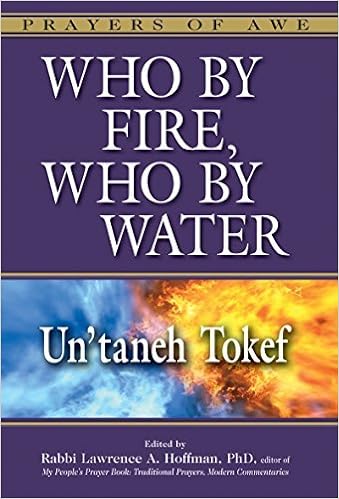
Preparing for these Holy Days I was reminded of an article Aaron wrote which was included in my teacher Rabbi Larry Hoffman’s masterful set of prayerbook commentaries, My People’s Prayerbook, published by Jewish Lights. Aaron’s piece is in a volume dedicated to unpacking the prayers of these High Holy Days which in a challenging reality is entitled Who By Fire, Who By Water. The volume tackles the challenging task of helping contemporary Jews and others face some of the most disturbing imagery contained in our High Holy Day Liturgy – the U’netaneh Tokef prayer. Aaron’s essay is entitled, “The Eternal and the Ephemeral: The Stark Contrasts of U-n'taneh Tokef.” Additionally, a small commentary of Aaron’s was included in the Reform movement’s new High Holy Day Machzor, Mishkan HaNefesh as one of a number of study texts on the U’netaneh Tokef.
Aaron’s words are especially chilling as Yom Kippur, our Day of Atonement looms: “Our actions help us live in such a way that when we suffer life’s darkest depredations, we will always have ways of coping with them. Our actions may not change the ultimate outcome one iota, but they alter our attitude, bolster our ability to withstand challenges, and help us handle unavoidable misfortunes better, and see life’s value amid chaos and dismay.” Aaron, even in death, you teach us. Your words, your words speak to the dark and disturbing reality so many of us have been trying to grapple with since May 5th.

I have been thinking about Aaron daily. I have been unable to push myself to write anything about him since his death. The best I was able to do was post a picture from a few summers back when my son Aaron and I, along with several friends, ran into Aaron Panken on Jerusalem’s Ben Yehuda Street after Shabbat had ended. But I set as my task, speaking some words about Aaron at Yizkor (the Memorial service) on Yom Kippur. That time has now come. So too will some words.
Being up here in NH’s North Country, where one cannot help but look at the sky, I have thought often of Aaron. May his soul be at peace. May the hearts of his loved ones find healing and some new form of wholeness in the aftermath of this tragedy. May all of us who knew Aaron, who learned, laughed and cried with him continue to feel his presence. May his memory be for each of, every day, a blessing.
To those who will be fasting, may it be an easy fast; and rather than making us fearful or sad, may Yom Kippur awaken us to life’s blessings and all the opportunities that lie before us in the New Year just begun.